

Search
In Zammad, you can search for all available information like:
- Message subject and text
- Names and email addresses
- Text in file attachments
- User and organization details (like notes, names, etc.)
Depending on what you are searching for and the amount of data in your Zammad instance, you can search in different ways. Read on to learn about the search basics, followed by the detailed search and the usage of Elasticsearch syntax.
Basic search
The search is located in the top left corner of the primary navigation. Either select it via mouse or use the keyboard shortcut s. After activation, you can see the tickets that were recently closed from your taskbar as well as your recent search queries. To search, simply type a term. The search then displays matching items for which you have at least view or read permissions, grouped by type like users and tickets. Selecting one of those results opens the item as tab in the taskbar. The number of results per type is limited: as soon as your search matches more than two types, each group shows up to five results. Use the detailed search to get the full result set.
Searching for a term also matches any values that begin with it. For example, searching for brooks also finds values like brookster. This does not apply when you use an attribute notation like owner.lastname:brooks (described in the Elasticsearch syntax section below), which matches exact values only.
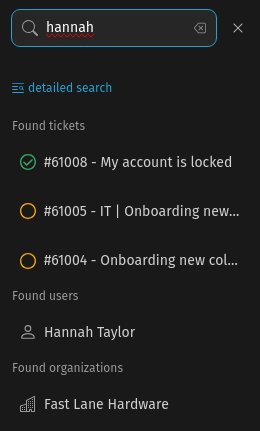
If you press enter or click on detailed search, Zammad opens the detailed search as a tab in the taskbar. There you can narrow down your search by selecting a specific object type (e.g. organization), using advanced filters or even using Elasticsearch syntax. Read on for more information.
Detailed search
Sometimes, a simple search term may not give you the results you are looking for. Zammad provides different options to narrow down the search in the detailed search page.
Advanced filters are not available for customer accounts. If your account has customer permissions only, the Search entity selector and the advanced filter options described below are not shown.
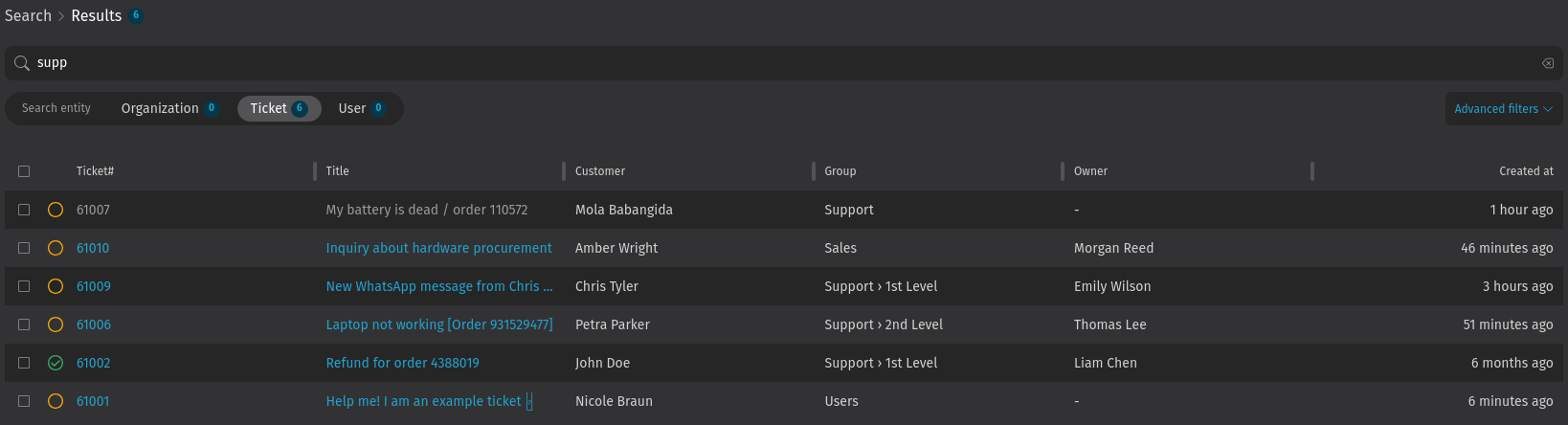
Sort the results
To sort the results based on the column's values, click on a column header. The sorting is indicated by an arrow. Click on the column again to change the sorting from ascending to descending and back.
Limit search to object type
Limit the search to an object type by using the Search entity tab selector below the search field (e.g. user or ticket). This limits the search to the selected object type and its related data. For example, when you select Ticket, the search also returns tickets where the owner or customer matches the search term. Knowledge base answers are available as an object type of their own, with title, visibility and update date as result columns. See Knowledge base for searching within the knowledge base.
Use advanced filters
Unlike the search field, you can filter the search results based on specific attributes and their values. To do so, click on the Advanced filters button on the right side, which opens an area where you can specify additional conditions based on specific attributes and their values. Choose an attribute and enter or select a value to match against. When using more than one filter, all conditions must be met; they are logically connected by AND. This also applies to the search term in the main search field.
Remove a single filter by hovering over it and clicking the that appears next to the value field. To remove all filters, click the x in the main search bar at the top next to the x filter(s) label and confirm the removal.
To add another filter, click Add filter below or between the existing filter rows and pick an attribute from the selection list. The list only offers attributes that are not used by any filter yet, so each attribute can be used only once.
In case you want to store or share your filter, you can do so by copying the URL. It includes the complete filter. Be aware that the search results may be different for other users due to divergent permissions.
If you still haven't found what you are looking for, you can benefit from the search being powered by Elasticsearch. You can find some examples in the next section.
Using Elasticsearch syntax
This is an advanced topic for power users. By using Elasticsearch syntax, you can exactly filter your data for specific attribute values. All indexed attributes are supported. Read on to find examples of how to use it or head over to the indexed attributes by Elasticsearch page where you can find a list with additional attributes.
Important information
- Make sure to select the relevant object in the Search entity switcher. For example
customer.lastnameis available for tickets, but not for users. - Multiple search terms are combined by a logical AND by default, so
smith openonly finds results containing both terms. Use an explicitORif you want either of them. - When combining an Elasticsearch query with advanced filters, be aware that all of the advanced filter conditions and the search syntax are logically connected by AND, so only results which match all of the advanced filter conditions and your search term will be displayed.
- To provide values containing a space, wrap them in
", e.g.priority.name:"2 normal".
Logic operators and ranges
You can combine conditions by using AND & OR as logical operators. Use TO to specify ranges for values with an order (e.g. integer or date). Include a limit of the specified range by using square brackets. Exclude it by using curly brackets. You can even combine those brackets, e.g. to include the lower limit and to exclude the upper limit. Nested terms can be achieved by separating them with parentheses ().
AND & OR with parentheses:
plain
owner.lastname:brooks AND tags:(internal OR onboarding)TO with asterisk wildcard:
plain
state.name:open AND article_count: [5 TO *]TO with excluding one limit of a range:
plain
article.created_at:[2025-03-21 TO 2026-05-19}Fuzzy search
If you are not sure about the exact spelling of a value, use the tilde (~) as suffix to perform a fuzzy search.
plain
owner.firstname:lawren~Negating search
If you want to exclude specified values, you can use negation !. To negate more than one term, use parentheses for all of them.
Exclude owner with last name "brooks":
plain
!owner.lastname:brooksExclude multiple conditions:
plain
owner.lastname:brooks AND !(tags:internal OR tags:onboarding)Regex
You can even use regex to search. Wrap the regex term in /.
plain
customer.lastname:/(bra?.n|doe)/